Voices from Germany: exile reporting
Berlin.- It’s 3 a.m. The phone rings. My mother, 72 years old, is alone in her apartment. She answers. A voice from a hidden number says: “We know your address. We’ll cut you into pieces.” Days later, security forces summon my brother for detention. My sister is told she’ll lose her job.
The one speaking is independent journalist Mahtab Qolizadeh, originally from Iran and one of the journalists living in exile in Germany. She was detained in 2021 by Iran’s Revolutionary Guard and sentenced to three years in prison. She was banned from practicing journalism, using social media, participating in public gatherings, and having any kind of social life. This is exactly what her court sentence states.
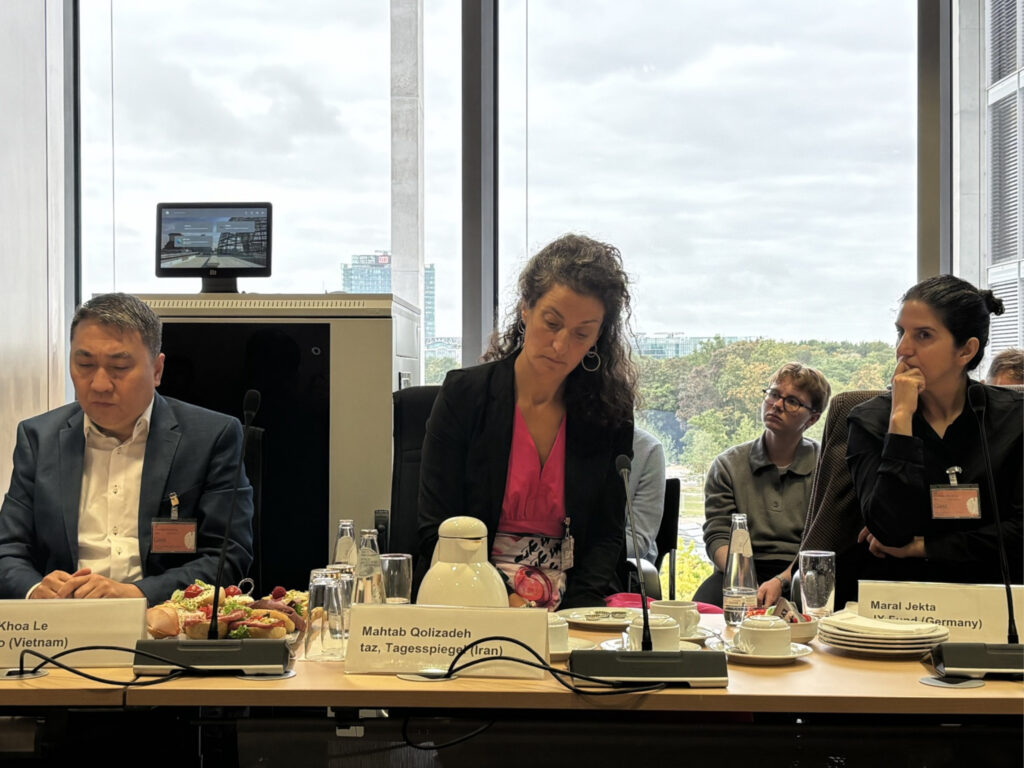
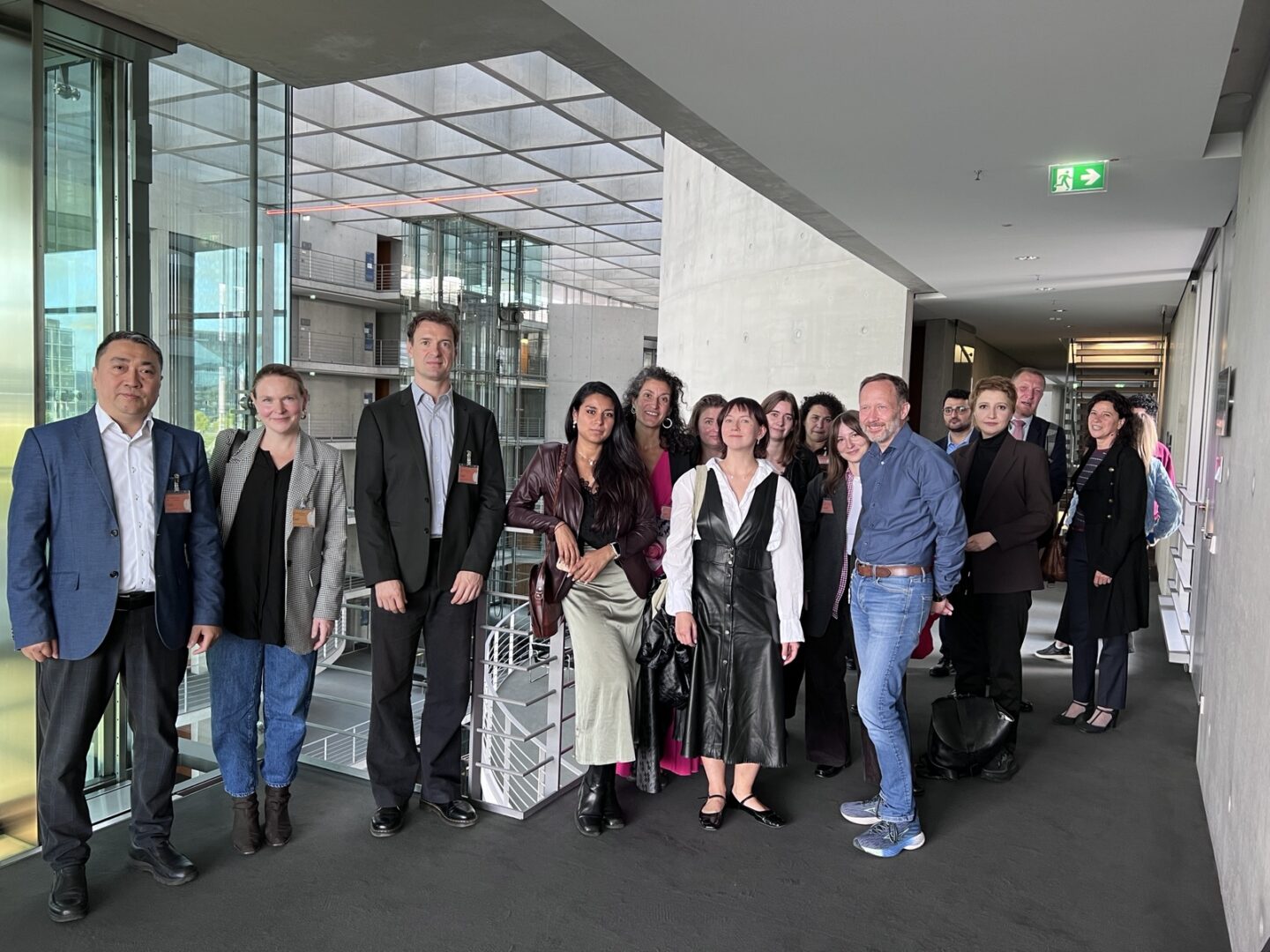
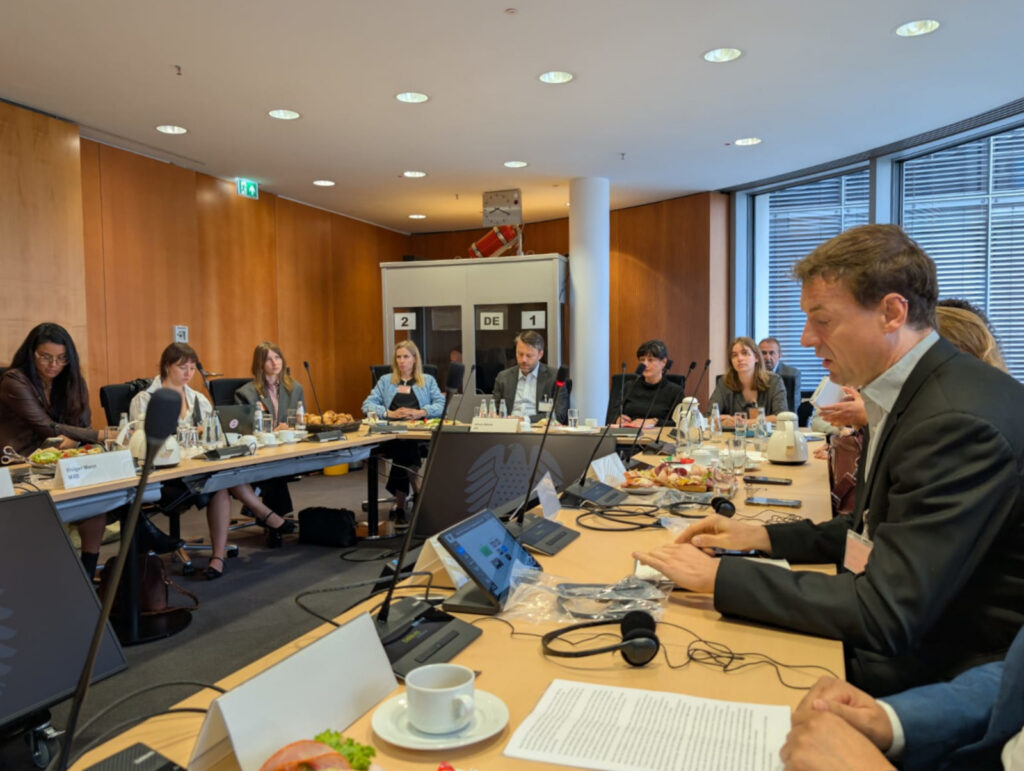
She, along with exiled journalists from Russia, Vietnam, Azerbaijan, Belarus, Venezuela and Mexico, attended the parliamentary breakfast organized by the taz Panter Foundation on September 10, whose work focuses on supporting journalists through different programs so they can continue their work, together with Jinn, a Berlin-based reference center for exiled media.
The goal: to exchange views with Bundestag members and representatives from federal ministries on why, in this context of transnational repression and the rise of authoritarian governments, it is more relevant than ever to talk about funding for media that must report from exile, and to find ways for journalists, from within Germany, to recover from the traumatic situations they’ve experienced without having to stop reporting.
It also aims to ensure cooperation against transnational repression, as well as the continuity of federal initiatives that support these journalists, such as the Hannah Arendt Initiative, run by Deutsche Welle, or funding programs such as the “Eastern Partnership and Russia.”
A clear example of transnational repression is the case of Le Trung Khoa, who has been under police protection in Germany for nearly ten years. Le, editor-in-chief of the Vietnamese outlet thoibao.de, described the threats he has faced despite having lived in exile for 20 years, and how his ad-funded outlet, with more than 20 million views a month, focused on politics and economics in Vietnam as well as on global politics, such as the war in Ukraine, continues to survive.
“In Vietnam, all media are censored by the state. At first I voluntarily submitted to that censorship. Since 2017 I stopped doing so, and I’ve had problems ever since. I receive death threats. At my office in Berlin, I get visits from Vietnamese people living in Berlin who offer me money to stop reporting on their relatives, who hold high political positions in Vietnam. I generally don’t give in to those demands, which in some cases leads to threats. The Vietnamese embassy in Berlin does everything it can to isolate me within the Vietnamese community,” he said.
He explained how, in 2024, unknown individuals broke into his car without stealing anything. “That same year, a man of Asian appearance whom I didn’t know photographed my house at night. Since 2018 I’ve been under police protection. Currently that protection operates 24/7, meaning I’m permanently accompanied by two police cars. This is connected to the fact that in 2025 the People’s Court of Hanoi sentenced me in absentia to 17 years in prison. My crime is journalism.”
After Le, Katerina Abramova spoke, Head of Communications at https://meduza.io/en, the world’s largest independent Russian-language news outlet, which, despite persecution and censorship, continues to report to the world from Berlin in its own language.
Katerina explained how she and her colleagues were forced to leave Russia to escape imprisonment and censorship.
Since 2014 they had operated out of Riga; however, the real exile began in 2022, following Russia’s full-scale invasion of Ukraine: “We were declared completely illegal by the Kremlin. Working for Meduza, supporting us with donations, or even sharing our materials is now a crime under Russian law.”
By 2026, the pressure had intensified. There are six criminal cases against Meduza’s co-founders and journalists, with sentences issued in absentia. “Our website and infrastructure are under constant DDoS attacks. Also this year, the Kremlin decided to gain full control over the internet. Now they’re coming after everyone, not just independent voices and sources of information. Shutdowns, whitelists and the blocking of all major platforms have become part of daily life for people inside Russia.”
Gemma Terés Arilla, director of the taz Panter Foundation, highlighted the importance of funding programs and fellowships for journalists at risk, such as the Rest&Resilience program, and pointed to the persistent difficulties in obtaining visas. As an example, she cited the situation of exiled Belarusians who are unable to renew their passports abroad.
For his part, Sergey Medvedev, founder of Jinn, underscored the crucial role played by exile newsrooms, which often represent the only alternative source of information for people in their home countries. He described the critical situation facing exile newsrooms and independent journalists following the cutoff of US funding, a major UK funding program, and cuts to German funding programs. (Link Jinn’s press release under the organization’s name, bolded).
Leyla Mustafayeva (Azerbaijan) and Vania Pigeonutt (Mexico) described cases of violence, intimidation and the killing of journalists. Gabriela Ramírez (Venezuela) warned that protection for journalists at risk should not depend on a change of government. As an example, she cited Syrian journalists, who lost their protected status after the fall of Assad, even though neither Syria nor Venezuela is any safer for the press today.
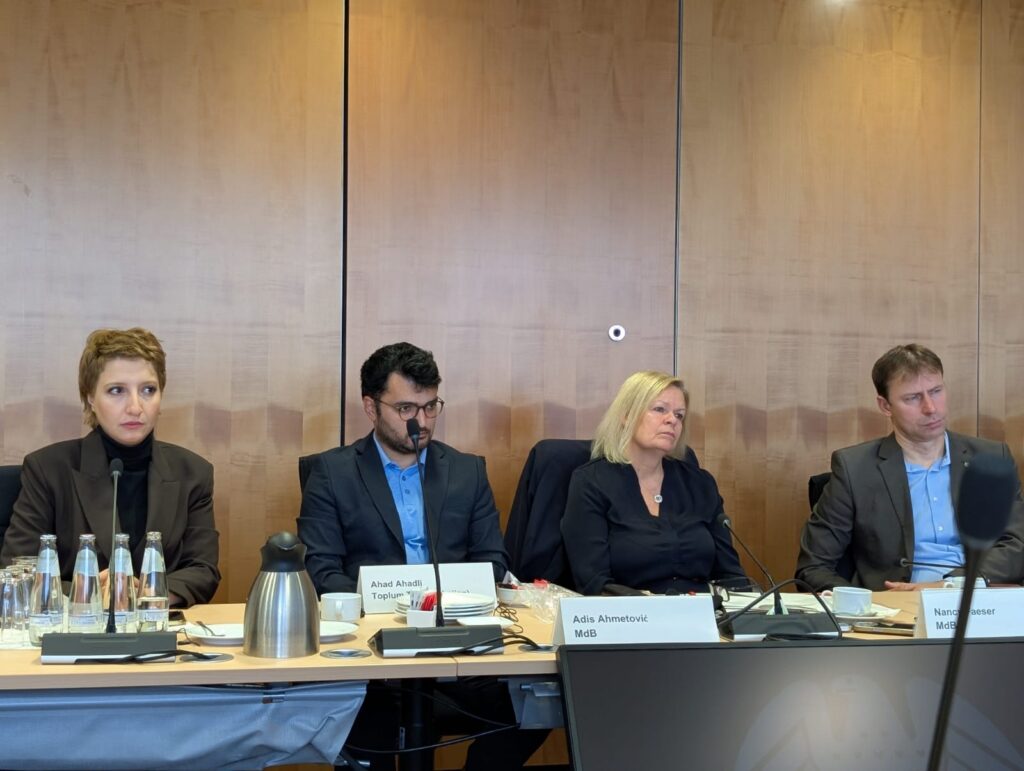
The event was organized in collaboration with German Bundestag members Adis Ahmetović (SPD) and Nancy Faeser (SPD). Also in attendance was Holger Mann, a member of the German Bundestag (SPD), who asked the journalists present to submit concrete cases of how Google, Meta and other platforms block their content while at the same time providing the infrastructure used for information manipulation, and suggested that these cases be raised through political channels.
Thomas Weichert (Federal Ministry of the Interior) explained that a simplified procedure for humanitarian visas remains a political matter requiring a new decision by the Federal Government, while the Foreign Office handles all other visa-related matters.
Claudia Gabriele Schmitz (Press Freedom Division, Federal Foreign Office) presented the Hannah Arendt Initiative, which supports journalists at risk on three levels: direct assistance to journalists in crisis regions, media hubs in neighboring countries, and cooperation with the Federal Government Commissioner for Culture and the Media. Alexis Below (advisor on Russia, Belarus and Ukraine) added that additional support is provided through the “Eastern Partnership and Russia” program.