Opportunities for journalists
14.10.2026 Free Press Awards Details
Criteria Free Press Awards
Nominations for the awards will be judged by an independent panel of international experts. Please note the following when nominating:
– You can not nominate yourself;
– When you nominate someone, make sure this person is aware and gives permission;
– Make sure you have sufficient examples of work to upload with the nomination, preferably a minimum of three pieces;
– To be eligible for the category of Newcomer of the Year, the nominee should be active as a journalist for a maximum of three years.
The Free Press Awards recognise journalists and media professionals who have a strong commitment with press freedom and independent information. We will honour journalists and media professionals who continue no matter what. Registration for the upcoming edition is open.
Free Press Unlimited wants to honor journalists who risk everything to bring us the news, media pioneers who pave the way for equality and justice and those who persevere under the most difficult circumstances. The Free Press Awards will recognise exceptional work in the categories Newcomer of the Year and Most Resilient Journalist.
08.10.2026 Journalismfund Europe : The Invisible Life Grant Details
Next deadline:
Thursday 27 August 2026 at 1 pm CET (Brussels time)
Thursday 29 October 2026 at 1 pm CET (Brussels time)
This programme supports cross-border teams of professional journalists and/or news outlets investigating issues related to farm animal welfare and European interests, both within and beyond Europe.
Many of the animals raised for our food supply remain largely out of sight of the public. This includes chickens, pigs and cattle, as well as species produced in large-scale breeding systems such as salmon, tilapia, catfish, scampi and sturgeon. The way these animals live, how their production is organised, and the social consequences of this are rarely discussed in detail.
08.10.2026 Vacancy – Editor, Moldova Details
Location: Moldova
Date: 7 October, 2026
Application Deadline: 21 October 2026
Contract Duration: Initial 6-month contract with the possibility of extension
Position overview
The OCCRP Regional Editor for Moldova is responsible for leading and coordinating local and cross-border investigations involving Moldova and the neighboring countries. The role requires hands-on editorial direction and collaboration with Moldovan member centers and partners, independent newsrooms, and freelancers. This position demands strong leadership skills, sharp investigative instincts, a collaborative spirit, and an in-depth understanding of the Moldovan political and media landscape, as well as regional geopolitical context.
07.10.2026 International Journalists’ Programme Details
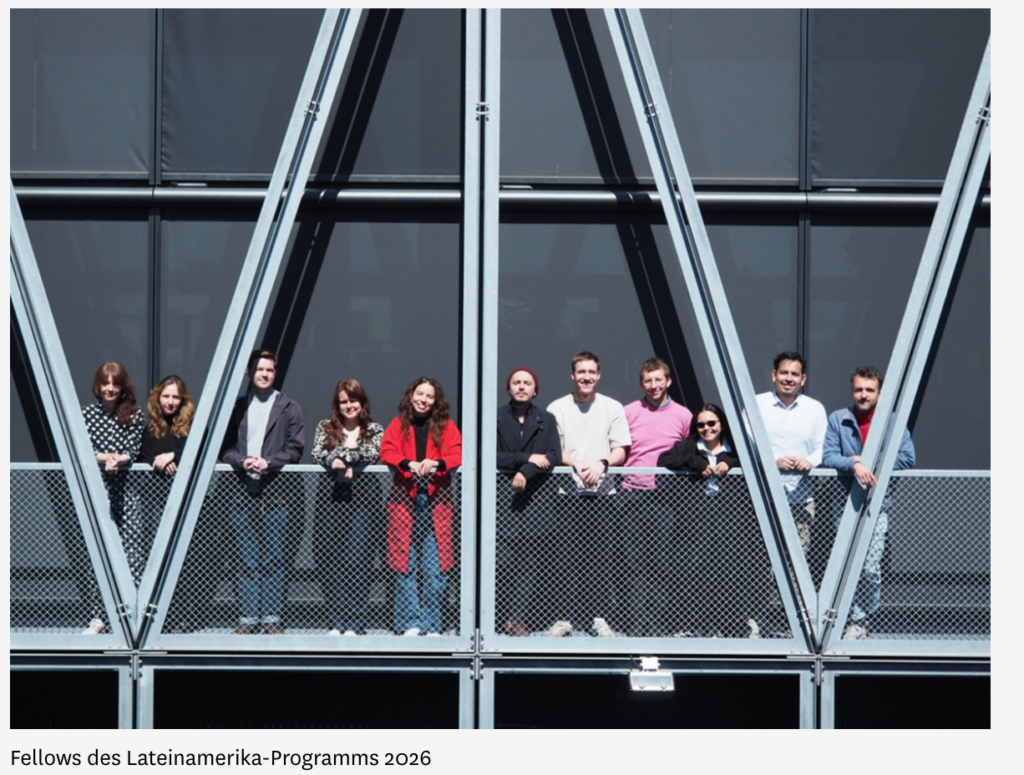
Applicants from Latin America must apply by November 22, 2026, via email to the press department of the German embassy or consulate general in their country. (see below)
For the year 2027, the International Journalists’ Programmes (IJP) are once again offering a fellowship program for Germany and Latin America. This gives talented journalists from Germany and Latin America the opportunity to work in another country for two months: on the one hand as short-term correspondents for their home editorial offices, and on the other as guest journalists in a media organization in Germany or Latin America.
What does the German-Latin American Fellowship Program aim to achieve? The IJP fellowship aims to offer journalists from Germany and Latin America the opportunity to deepen their existing knowledge and gain new experiences. During their two-month working stay, they are expected to follow current developments in the country and learn to better assess background contexts. Just as important: gaining an impression of journalism in the host country. The program does not end after the two months: a vibrant alumni network aims to strengthen long-term personal and professional ties between Germany and Latin America.
Who can apply? Journalists aged 25 to 38 who have proven professional full-time experience—meaning they should have completed their degree and, where applicable, a traineeship—are eligible to apply. German journalists should reside in Germany and work for German media, while Latin American journalists should reside in Latin America and work for local media. Permanent correspondents are excluded from applying. Employees of public authorities, PR agencies, or press offices are not eligible for this fellowship. Applicants should have a good command of the host country’s language. For participants from Latin America, an excellent command of English is generally sufficient. The application deadline is November 22, 2026.
When does the fellowship take place? The fellowship begins for all fellows with a multi-day introductory seminar from April 24 to April 28, 2027, in Berlin. The stay of the Latin American fellows in Berlin will take place in May and June.
For the fellows from Latin America, a one-week trip to two or three German cities is scheduled for late May; participation here is also mandatory. On the weekend of June 26–27, 2027, another joint seminar will be held for all fellows. The two-month stay of the German fellows in Latin America begins between June 28 and July 11, 2027, and can be extended individually by a maximum of one month. Participants from Germany will meet again after their return on Saturday, October 9, 2027, in Berlin. Attendance at all events is mandatory.
07.10.2026 The New York Times Local Investigations Fellowship 2026 Details
Applicants should have:
- Three to five years of professional reporting experience covering a beat for a local newspaper or local digital news outlet.
- Experience as either an independent journalist or a journalist employed by a newsroom that is willing to provide a yearlong sabbatical.
- Authorization to work in the United States.
The New York Times describes its mission as seeking the truth and helping people understand the world, with independent journalism at the center of its work.
The Local Investigations Fellowship supports that mission by giving local journalists the opportunity to develop and pursue substantial investigative projects. Rather than simply providing a conventional newsroom position, the fellowship is structured around a specific investigative reporting idea or area of focus that the journalist wants to explore.
Successful fellows spend approximately one year working on investigative journalism focused on their state or region. Their work is expected to result in signature investigative reporting that will be published by The New York Times.
The fellowship combines practical reporting with editorial mentorship. Fellows remain based in the communities they cover, allowing them to maintain the local knowledge, relationships and sources needed for effective community-based investigative reporting. Periodic trips to The New York Times offices are also part of the program for training and support.
06.10.2026 The Temporary Relocation Programme Details
The Temporary Relocation Programme provides financial support to a host organization responsible for implementing the relocation of a selected human rights defender.
Programme Priorities
The programme is designed to provide financial support for relocation which offers the following essential components:
(1) Holistic approach addressing various needs of human rights defenders during the relocation such as: rest and respite, professional capacity development, expanding the network of contacts, emotional and psychological well-being, family support, among others.
(2) Gender perspective to ensure the safety and well-being of all human rights defenders, taking into account the unique challenges and risks faced by women, non-binary and trans individuals, and other gender minorities.
(3) Sustainability of post-relocation phase in order to ensure that HRD will be able to continue their human rights work.
The Temporary Relocation Programme allocates funds for the relocation of HRDs with the intention of returning to their home country or region if circumstances allow, and who plan to continue their human rights work following the conclusion of their relocation.
The programme provides support for a temporary period (up to 1 year), and does not facilitate permanent relocation and/or asylum procedures.
Try changing your search parameters.